William Lloyd Garrison by John Jay Chapman
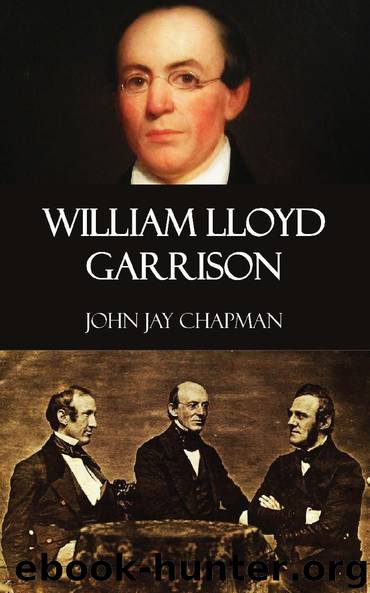
Author:John Jay Chapman
Language: eng
Format: epub
Publisher: Perennial Press
CHAPTER 7: THE MAN OF ACTION
~
IN CALLING UP THE SPIRIT of Garrison out of the irrecoverable past we must never forget that he was but a part of something;we must call up the whole epoch. Garrison was as much an outcome of slavery as was “Uncle Tom’s Cabin” or John C. Calhoun. He is a spiritual product; he is that suppressed part of man’s nature, which could not co-exist with slavery. He is like a fiery salamander, who should emerge during a glacial epoch — crawling out from a volcano that was all the time hidden beneath the ice-crust. It is through the hot breath of this salamander that verdure is to be brought back to the earth, and the benign climate of modern life restored to America. To the conservative minds of his own time he appeared to be a monster; and he was a monster–a monster of virtue, a monster of love a monster of power.
Let us not judge but only examine him. Fortunately the materials are abundant, the record is complete. His life in four enormous volumes has been written by his children; and the children of Garrison suppress nothing. We are brought into absolute contact with all of Garrison’s singularities. This biography is not a critical work: it is, one might say, a work of idolatry. Every little battle is fought over again, and every word or gesture of the protagonist is deemed sacred. The reader feels oppressed by the one-sidedness of this procedure. One becomes sorry for the other actors in the great drama: for after all, these men could not help it that they were not Garrison; they seem to live out their lives under the pitiful inferiority of not being Garrison. For instance, Cassius M. Clay of Kentucky went to Yale College, and was, as a youth, converted to Anti-slavery by a lecture of Garrison’s at New Haven. Clay returned to Kentucky, emancipated his slaves, and thereafter made relentless war on slavery, thus furnishing, say Garrison’s biographers, “an example without parallel both of heroism and of the folly of attempting to undermine the slave power from within.” The italics are mine. But why do Garrison’s children think it folly for a Southerner to agitate against slavery in Kentucky? It seems to me that to do so was right. I believe that the agitation of Clay in Kentucky somehow went to a spot in the slavery question that nothing else could have reached. It affected Garrison himself as nothing else ever affected him: it softened him. It was the conduct of Clay and Rankin (another Southerner) which caused Garrison to offer a resolution at the Cincinnati convention in 1853, in which he stated that the Abolitionists of the country were as much interested in the welfare of the slaveholders as they were in the elevation of the slaves. His habitual attitude towards the slaveholders had always been, “We do not acknowledge them to be within the pale of Christianity, of Republicanism, of humanity. This we say dispassionately, and not for the sake of using strong language.
Download
This site does not store any files on its server. We only index and link to content provided by other sites. Please contact the content providers to delete copyright contents if any and email us, we'll remove relevant links or contents immediately.
Fanny Burney by Claire Harman(26607)
Empire of the Sikhs by Patwant Singh(23090)
Out of India by Michael Foss(16861)
Leonardo da Vinci by Walter Isaacson(13341)
Small Great Things by Jodi Picoult(7156)
The Six Wives Of Henry VIII (WOMEN IN HISTORY) by Fraser Antonia(5519)
The Wind in My Hair by Masih Alinejad(5103)
A Higher Loyalty: Truth, Lies, and Leadership by James Comey(4967)
The Crown by Robert Lacey(4820)
The Lonely City by Olivia Laing(4808)
Millionaire: The Philanderer, Gambler, and Duelist Who Invented Modern Finance by Janet Gleeson(4482)
The Iron Duke by The Iron Duke(4367)
Papillon (English) by Henri Charrière(4278)
Sticky Fingers by Joe Hagan(4207)
Joan of Arc by Mary Gordon(4117)
Alive: The Story of the Andes Survivors by Piers Paul Read(4037)
Stalin by Stephen Kotkin(3973)
Aleister Crowley: The Biography by Tobias Churton(3646)
Ants Among Elephants by Sujatha Gidla(3470)
